Introduction
IN THIS LESSON
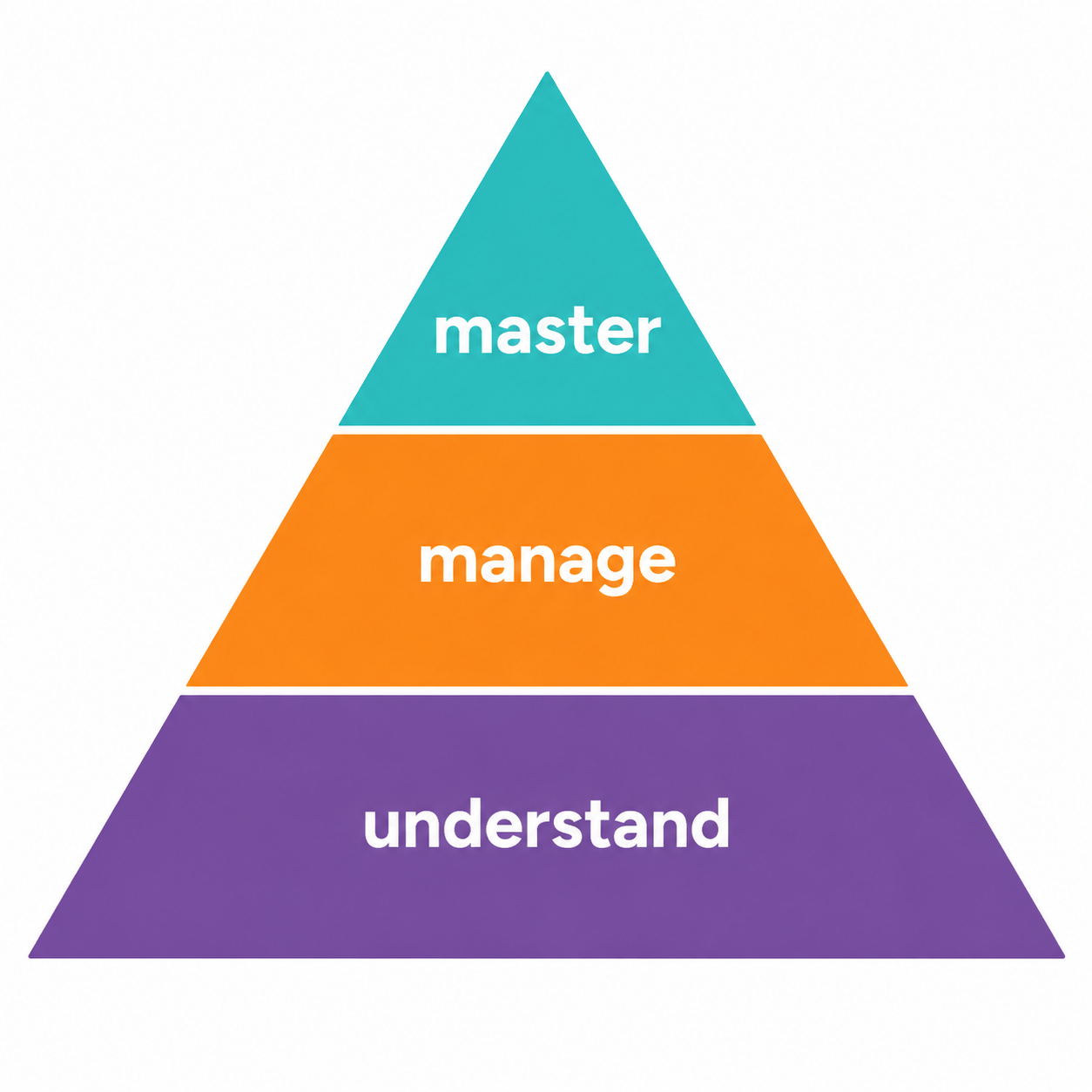
We look at trauma recovery as three stages that build upon one another.
We cannot begin to manage our trauma until we can understand it.
I’m a “context” guy. I thrive when I have a framework that allows me to understand a problem, identify what’s relevant, and choose appropriate solutions. Without context, I feel directionless. So that’s the primary reason I wrote this guidebook. I figure that there must be others who could benefit from such architecture.
It wasn’t until I could define the context of my trauma experience that I could journey through it in a healthy, healing way. Unfortunately for me, that took 12 years. That’s a dozen years of constant frustration, bewilderment, and emotional damage to myself and those around me. In one way, I feel like those became wasted years.
In creating this course, I want to help you minimize the amount of wasted time so you can heal as efficiently as possible and with as little damage as possible.
For me, context appeared as a pyramid. I had been familiar with Mazlow’s Hierarchy of Needs, in which American psychologist Abraham Mazlow defined and prioritized the needs that motivate behavior. Lower-priority needs (safety needs, for example) cannot be met until the higher-priority need (physiological needs like food and water) is fulfilled. Mazlow showed this as a pyramid, with one need layered on top of another—all the way up to self-actualization.
In looking at Mazlow’s hierarchy pyramid, I realized a similar pattern when it came to trauma. I explored the idea more deeply and the result was a three-layered, progressive hierarchy trauma pyramid I call the UMM Model (Understanding, Managing, Mastering).
Understanding Trauma
At the base of the pyramid is understanding. We must understand what trauma is and how it affects us before we can start healing. People can’t fix something they haven’t defined. You might as well be throwing darts blindfolded and hoping you hit the target. That’s what I was doing during those 12 years.
Managing Trauma Triggers
Once we’ve come to a firm understanding of what trauma is and how its triggers affect us we can start healing. That happens by assembling a toolbox of strategies and techniques that allow us to manage triggers in a healthy, positive way. This process involves experimenting with different methods and finding what works. You will notice some work better than others for you. You might also notice that some work better at different times in your post-trauma journey.
Mastering the Recovery
Once you’ve found successful management tools, you’ll want to build up a habit. This rinse and repeat allows you to see triggers at or even before their onset. You’ll begin to reflexively initiate tools that allow your healthy response to override the fight/flight/freeze your body and mind attempts to kickstart. You’ll label triggers as minor inconveniences rather than four-alarm fires.
I’ve divided this guidebook into these three sections so we can take a closer look at each. I’ll share examples and best practices along the way. My hope is that when you reach the end of this book you will have a foundation for self-discovery that allows you to move forward in your post-trauma healing journey.
Full disclosure: I’m not a professional therapist, so I leaned into Artificial Intelligence fed by trauma-related resources to fill in the gaps so that I could feel comfortable providing sound advice that aligns with counselors and psychologists. You’ll find a list of sources at the end of this guidebook that Microsoft Copilot drew from when I referred to the AI engine for guidance.
So let’s jump in using the UMM Model as our main tool.